ID: 2696
Photograph album: H.M. Factory, Gretna
WORLD WAR ONE
Category: History
Place/Publisher/Date:
Gretna, No publisher.c.1916-1918.
Description:
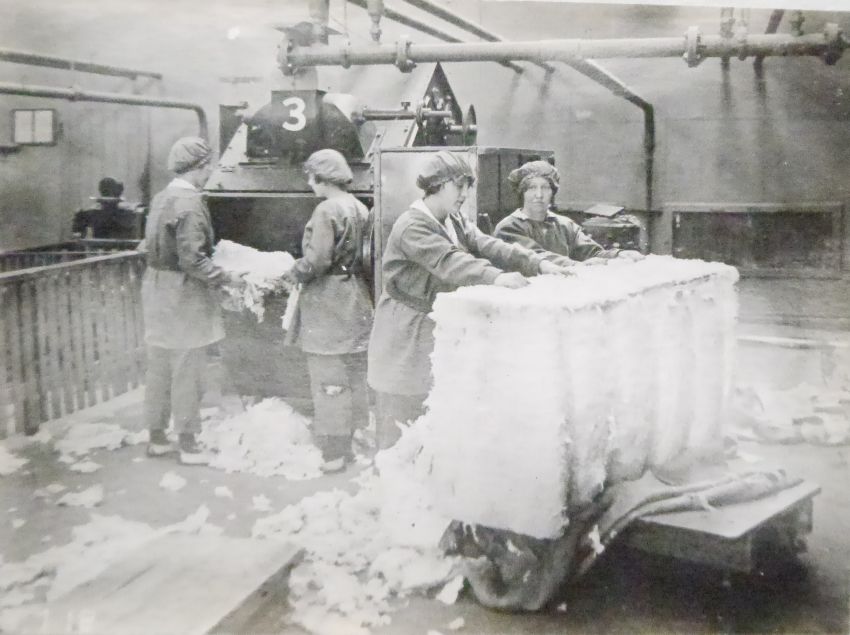
Photograph album c.1916-1918 of H.M. Factory, Gretna, with 102 mounted silver gelatin prints of various sizes with pencil captions including a large folding panoramic view of the exterior of the site; original brown card covers. During World War One, Gretna was the site of the Britain's largest cordite factory, constructed in response to the Shell Crisis of 1915. Women workers came from all over the UK to make "Devil's Porridge", a mixture of gun cotton and nitro-glycerine that was used to produce cordite as a shell propellant. This hazardous work turned their skin yellow and earned them a nickname - the Canary Girls. The prints depict women working on the various processes including loading the nitration pans; "Bale Breaking" (physically tearing apart compressed bales of raw cotton waste for processing) "Unloading", "Beating", "Potching" (a washing and purification step where nitrocotton was placed into large washing machines, known as "potchers" or "potching engines", the boiled nitrocotton rag was agitated, and calcium carbonate was added to the mixture as a stabilizer for safety before it was further processed), "Wringing" (removing excess acid from nitro-cotton), "Bagging", "Pouring On" (pouring nitroglycerine into canvas bags). Other images of the factory including the narrow gauge railway and offices. H.M. Factory, Gretna stretched nine miles from Mossband near Longtown in the east, to Dornock/Eastriggs in the west. It consisted of four large production sites and two purpose-built townships, its own independent transport network, power source, and water supply. Construction work started in November 1915 under the supervision of S P Pearson & Sons. Up to 10,000 Irish navvies worked on the site and production started in April 1916. Engineers and chemists from nations throughout the British Empire were employed to establish the production of Cordite. By 1917 the largest proportion of the workforce were women: 11,576 women to 5,066 men. The suffragette and novelist Rebecca West admired the "pretty young girls" but also noted that they were contained on a site "ringed with barbed war entanglements and patrolled by sentries". Their enjoyment of community facilities was limited by long working hours, sometimes stretching into the night. Their only free day was Sunday, and public transport was limited with trains to Carlisle cancelled because alcohol was on sale there. Inevitably, there were serious incidents resulting in deaths. It is estimated that deaths from poisoning and explosions were around 300, excluding those who died subsequently. Munitions work during World War I was a major factor in shifting public opinion and political will towards granting women the vote in 1918. The 1918 Act: The Representation of the People Act was passed partly to reward this service, though it initially granted the vote only to women over 30 who met property qualifications and thus excluding nearly all the women who worked in munitions factories.
Price £1750.00